



Why Vintage Football Cards Feel Undervalued
Why Vintage Football Cards Are Still Undervalued in Today’s Hobby
Vintage football cards remain one of the best values in the entire sports card market. The segment has history, Hall of Fame players, recognizable rookie cards, low-population condition rarities, and a visual identity that spans some of the hobby’s most memorable designs, yet it still trades at a discount to comparable baseball and basketball material. For collectors and investors who care about scarcity, iconic players, and long-term relevance, that gap matters. It suggests that vintage football has not yet been fully priced for what it actually represents in the broader collecting landscape.
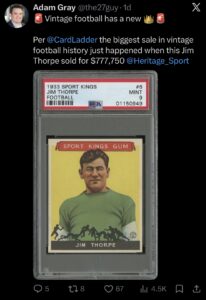
The case for vintage football being undervalued is not built on one single card. It is built on the entire structure of the category. Football cards from the 1950s, 1960s, 1970s, and even early 1980s often combine lower surviving supply, major condition sensitivity, and legendary player pedigrees, but many still remain attainable in collector grades or even strong mid-grades. In a hobby that regularly chases modern scarcity manufactured by serial numbers, parallels, and premium releases, vintage football offers genuine age-based scarcity and cultural importance without demanding the same level of capital as similarly iconic cards in other sports.
This matters because football is not a fringe American sport. It is the dominant sport in the United States from a television, cultural, and fan-engagement standpoint, and its legends remain central figures in American sports history. Yet when collectors compare the cost of key football cards to the cost of equivalent baseball and basketball cards, football often looks surprisingly cheap. The disconnect between the cultural power of the NFL and the relative affordability of many of its vintage cards is the clearest reason the category still deserves the label undervalued.
The market still prices football below its cultural weight
A large part of the undervaluation argument begins with perception. Baseball has the longest card history and basketball benefits from global star power, while football has often been treated as a secondary vintage category despite enormous domestic popularity. That imbalance has consequences. Hall of Fame football players with historically important rookie cards often trade below the levels many collectors would expect if they judged them only by greatness, scarcity, and long-term demand potential.
Sports Collectors Daily noted that pre-1975 football Hall of Famers often still represent “bang for the buck,” even while some rookie cards have begun to rise. Sports Illustrated made the same broad point in early 2026, writing that vintage football remains one of the hobby’s more under-appreciated segments even after several individual cards posted major gains. When a market can both experience strong growth and still be described as under-appreciated, that usually means the category has not yet gone through full re-rating. That is where vintage football sits today.
There is also a practical reason football has lagged. The hobby built many of its long-standing prestige hierarchies around baseball first. The result is that collectors are often conditioned to view a football card through a lower pricing lens than a baseball card of similar age and quality. That inertia does not change overnight, but it creates opportunity for collectors who are willing to buy the best football cards before broader hobby consensus catches up.
Scarcity in vintage football is more real than many people realize
One reason vintage football remains a strong value is that true supply is often tighter than headline impressions suggest. Football cards were not historically produced, saved, or condition-preserved in the same way as baseball cards, especially in the earlier decades when baseball still dominated card culture. Sports Collectors Daily emphasized that far fewer vintage football cards exist in high quality because football simply did not enjoy the same level of popularity in the card market during the 1950s, 1960s, and 1970s.
That scarcity shows up most clearly in condition-sensitive sets. The 1971 Topps Football issue is one of the strongest examples. Its red-and-blue borders are notorious for showing wear, which makes high-grade rookies of Terry Bradshaw and “Mean” Joe Greene particularly difficult. PSA itself has described 1971 Topps Football as one of the most challenging football sets of the 1970s and 1980s, reinforcing why mint-level examples can command so much respect when they appear.
The same pattern appears across the decade. Cardboard Connection notes that 1970s Topps football is loaded with elite Hall of Fame rookies including Terry Bradshaw, Roger Staubach, Walter Payton, O.J. Simpson, Steve Largent, Earl Campbell, Joe Greene, Tony Dorsett, and Lynn Swann. When a single decade contains that many cornerstone names and those cards are not easy to find clean, demand does not need to become irrational for prices to move higher. It only needs more collectors to recognize how difficult nice copies really are.
The set argument: undervaluation is visible across entire releases
Vintage football is not just about isolated grails. Several full sets remain underrated relative to aesthetics, rookie content, and collecting appeal. Sports Collectors Daily specifically identified five undervalued vintage football sets, underscoring that this is a set-level issue, not merely a handful of individual bargains.
1970 Topps Football
The 1970 Topps set is one of the most interesting football releases of the decade because it blends strong veterans with a genuine headline rookie in O.J. Simpson. Cardboard Connection points out that despite lacking NFL and team logos, the set is filled with Hall of Fame veterans such as Gale Sayers, Bart Starr, Johnny Unitas, Fran Tarkenton, and Dick Butkus, while Simpson’s rookie anchors the checklist. That combination matters. Sets with one major rookie plus multiple all-time legends often age well because they appeal to both player collectors and full-set builders.
The set also offers secondary opportunities that support the undervaluation case. Alan Page’s rookie is in the same release, and he remains one of the greatest defensive players in league history. Defensive players historically receive less hobby attention than quarterbacks and running backs, but Page’s résumé is extraordinary, and his rookie still tends to get less mainstream hobby conversation than it deserves. If a set contains a top offensive rookie, a top defensive rookie, and multiple iconic veterans, yet still does not carry the prestige premium of comparable baseball issues, that is a textbook example of an undervalued vintage set.
1971 Topps Football
The 1971 Topps Football set may be the clearest example of condition-driven undervaluation. The design is bold and memorable, but the borders chip easily, making clean copies very difficult. That difficulty is exactly what should make the set more appreciated. It holds the rookie cards of Terry Bradshaw and Joe Greene, two foundational figures in the Steelers dynasty, and it sits at the intersection of visual appeal and real scarcity.
Bradshaw’s rookie should command broader hobby reverence than it often gets. He is a four-time Super Bowl champion quarterback and a centerpiece of one of the NFL’s defining dynasties. Quarterbacks tend to drive demand, and yet Bradshaw’s card conversation still feels muted compared to vintage quarterbacks in baseball or basketball-adjacent hobby culture. Joe Greene’s rookie in the same set strengthens the release further. Greene is one of the greatest defenders in league history, and his card gives the set a second pillar beyond Bradshaw.
1972 Topps Football
The 1972 Topps Football set is one of the most important issues of the decade because it houses Roger Staubach’s rookie card and John Riggins’ rookie card, while also featuring memorable veteran material and one of the more distinct visual styles of the period. JRI Cards specifically highlighted the 1972 Topps Roger Staubach rookie as an undervalued vintage football card, noting both his legendary status and the relative affordability of the card compared with many Hall of Fame contemporaries.
Staubach is exactly the kind of player who should anchor a stronger vintage football market. He is an iconic Cowboys quarterback, a Super Bowl champion, an MVP, and a player whose appeal extends beyond team collecting because of his place in NFL mythology. In many other hobby categories, a card with that mix of team significance, national recognition, and quarterback status would have already seen broader pricing expansion. The fact that Staubach still gets described as affordable is an argument in itself.
1973 Topps Football
The 1973 Topps Football set is a quietly loaded release. Cardboard Connection highlights rookie cards of Franco Harris, Ken Stabler, Dan Dierdorf, and Jack Ham. That is an unusually deep group. Harris and Stabler alone would be enough to make a vintage football set notable, but the supporting rookie cast adds serious historical depth.
Franco Harris is one of the most important running backs of the 1970s, and his place in Steelers lore gives his rookie card lasting relevance. Ken Stabler’s card is equally compelling because he combines quarterback scarcity appeal with Raiders branding, MVP pedigree, and a style of play collectors still romanticize. Set depth is often underappreciated when the hobby focuses on one-card headlines. The 1973 Topps set deserves more credit because it provides multiple Hall of Fame entry points in a single release, which is often how truly strong vintage sets are built.
1975 Topps Football
The 1975 Topps Football set does not always receive the same hobby discussion as 1971, 1972, or 1976, but it is loaded with meaningful rookie cards. Cardboard Connection notes that the set offers rookies of Mel Blount, Dan Fouts, Drew Pearson, Rocky Bleier, and Lynn Swann. Dan Fouts gives the set a Hall of Fame quarterback anchor. Lynn Swann gives it one of the signature wide receivers of the 1970s. Mel Blount adds defensive gravitas.
This is the kind of release that often gets overlooked because it lacks one overwhelming headline rookie. Yet that can create value. A set with multiple historically significant names can stay cheaper simply because no single card dominates the discourse. That dynamic can be useful for collectors because it keeps the entire issue more affordable than its content would otherwise suggest.
1976 Topps Football
No discussion of undervalued vintage football can ignore the 1976 Topps set. Walter Payton’s rookie card is the star, but the checklist also includes rookie cards of Jack Lambert, Ed “Too Tall” Jones, and Randy White. Payton’s card is one of the defining football rookies of the decade and has every element the hobby claims to love: all-time greatness, visual simplicity, strong brand recognition, and cross-generational respect.
And yet even this set can still feel underrated in the context of broader sports cards. Payton is one of the most beloved running backs in NFL history. His card has prestige, but it still does not command the kind of market gravity that equivalent all-time-great rookie cards in other sports can create. The supporting cast matters too. Lambert and White are not hobby headline names in the same way, but they deepen the set and give it defensive Hall of Fame credibility that many vintage issues cannot match.
The player argument: specific legends still look cheap for what they are
Undervaluation becomes easier to understand when it is tied to names collectors already know. Several football legends have rookie cards or early cards that still feel inexpensive relative to the significance of the players.
Johnny Unitas
Sports Collectors Daily singled out the 1958 Topps Johnny Unitas as a card to watch, arguing that while his 1957 rookie has already soared, the 1958 second-year card remains modest by comparison. That idea matters because second-year and early-career cards often become value plays after rookie cards move beyond broad collector budgets. Unitas is one of the foundational quarterbacks in NFL history. A visually attractive late-1950s Topps card of a player that important should not feel like a bargain, yet many examples still do.
Bart Starr
The same article made a similar case for the 1958 Topps Bart Starr second-year card, describing it as undervalued and within reach even with a relatively low population of high-grade examples. Starr’s legacy is enormous: Packers dynasty, multiple championships, and one of the key quarterback names in football history. If collectors regularly chase championship pedigree in modern quarterbacks, it is difficult to argue that Starr’s early cards should remain on the sidelines of the vintage market.
Jim Brown
Jim Brown’s 1958 rookie is already acknowledged as a major card, but Sports Collectors Daily pointed to the 1959 Topps Jim Brown as both visually superior and still relatively modest in near-mint condition. This is where football’s undervaluation becomes especially clear. Brown is not just a Hall of Famer; he is commonly discussed as one of the greatest running backs ever and one of the most dominant athletes of his era. When the second-oldest card of that kind of player can still be obtained for a fraction of what collectors might expect in another sport, the category remains mispriced.
Joe Namath
Joe Namath has one of the iconic quarterback rookies in the hobby, but even his second-year and later 1960s cards have been identified as relatively affordable when compared with his stature. Sports Collectors Daily specifically mentioned the 1966 Topps Joe Namath as a card that had risen but still looked affordable at high grades. Namath is not merely a statistical legend. He is a cultural icon, a Super Bowl symbol, and one of the most recognizable personalities the league has ever produced. Cards of players who resonate beyond the stat sheet often prove resilient over time because they appeal to a wider pool of collectors.
Roger Staubach
Roger Staubach deserves special attention because he sits at the center of the undervaluation thesis. JRI Cards directly called his 1972 Topps rookie relatively affordable despite legendary status. Sports Collectors Daily also flagged his 1973 second-year card as still extremely affordable, even as his rookie has become more expensive at the top end. Staubach is the type of quarterback whose cards should serve as a benchmark for the category. He played for the Cowboys, won titles, and remains part of NFL iconography. When a player that important still has multiple accessible vintage cards, the hobby has not fully priced in his legacy.
Steve Largent
Steve Largent is one of the best examples of a player whose greatness outpaces his hobby profile. JRI Cards argued that Largent, a prolific receiver and the first Seahawk inducted into the Pro Football Hall of Fame, remains undervalued partly because wide receivers historically receive less attention. Cardboard Connection also lists Largent among the hotly pursued rookies of the 1970s, yet his rookie rarely sits at the center of mainstream vintage football conversations. That gap matters. The hobby eventually corrects some of these positional blind spots, especially when the player’s résumé becomes impossible to ignore.
Ronnie Lott
Ronnie Lott is another player whose hobby standing lags behind his football stature. JRI Cards highlighted him as an undervalued vintage rookie, noting that while Joe Montana and Jerry Rice often capture 49ers-era attention, Lott was the safety who terrorized offenses. Defensive players often trade at discounts because the hobby has historically prioritized quarterbacks and skill-position stars. But collectors increasingly value historical completeness and team-dynasty context. In that environment, early Lott cards look stronger than their pricing suggests.
Terry Bradshaw
Terry Bradshaw’s rookie belongs in any serious discussion of football undervaluation because it combines quarterback importance with one of the toughest mainstream 1970s sets. Four Super Bowl titles, massive name recognition, television crossover, and Steelers dynasty relevance should make his card a more obvious hobby centerpiece. Instead, Bradshaw often feels respected but not fully exalted. That is a subtle difference, but it matters. Respect creates steady demand. Exaltation creates pricing multiples. Bradshaw still seems closer to the first category than the second.
Walter Payton
Walter Payton’s rookie has long been a hobby pillar, but even it reinforces the broader undervaluation argument. Payton is universally respected, and his 1976 Topps rookie is one of the most recognizable football cards ever made. Yet football collectors still regularly discuss the card as attainable in a way that comparable all-time-great rookies in other sports often are not. That does not mean Payton is cheap in absolute terms. It means the card still feels underpriced relative to the player’s all-time status and the emotional attachment collectors have to him.
Joe Montana and Jerry Rice
Once the conversation moves into the early 1980s, the undervaluation case does not disappear. Joe Montana’s 1981 Topps rookie and Jerry Rice’s 1986 Topps rookie are among the most important football cards of the decade. They have gained value, but they still sit in a hobby ecosystem where many collectors believe football legends should be worth even more, particularly at the high end. Pull Market recently framed the 1976 Payton, 1981 Montana, 1986 Rice, and 1986 Steve Young rookies as four Hall of Fame pillars every NFL collection needs, reinforcing how central those cards are to the category.
Montana is a useful case study because he is not just a great player; he is one of the defining quarterbacks in football history. Rice is the corresponding example at wide receiver. His 1986 Topps rookie is one of the great football cards of any era, yet it still illustrates the ceiling football has not fully reached. A six-figure PSA 10 Rice rookie exists, but the broader football market still feels comparatively restrained relative to the aura surrounding the player.
Position bias creates buying opportunities
One of the biggest reasons vintage football remains undervalued is that the hobby has always displayed position bias. Quarterbacks receive the bulk of mainstream attention. Running backs come next. Wide receivers, offensive linemen, defensive backs, and defensive linemen often trail significantly behind, even when the players are all-time greats. That bias creates inefficiencies.
Alan Page, Joe Greene, Jack Ham, Mel Blount, Ronnie Lott, Randy White, and John Hannah are all historically important names, yet defensive and line-oriented collectors know those cards often do not receive the pricing love given to quarterbacks. The same logic applies to receivers such as Steve Largent and Lynn Swann. Football history is larger than passing numbers. Vintage football cards become more interesting when collectors appreciate how much value is still hidden in the non-quarterback tiers.
This is not a small point. Markets often become undervalued precisely because they simplify too aggressively. If the hobby only prices vintage football through quarterback headlines, then deep-position legends can stay underpriced for years. That creates room for informed collectors to build stronger portfolios and more interesting collections without having to compete for the same handful of cards everyone else knows.
Vintage football offers more design variety than it gets credit for
Another reason the category is underrated is aesthetic neglect. Football collectors talk about players and scarcity, but the sets themselves are often visually excellent. The 1970s Topps run alone offers a wide range of looks: the logo-less but star-studded 1970 issue, the condition-sensitive bordered drama of 1971, the bold colors of 1972, the portrait-driven 1973 release, and the classic simplicity of 1976.
Set design matters because collectors do not buy only statistics. They buy imagery, nostalgia, texture, and era-specific feel. Sports Collectors Daily argued that undervalued vintage football sets deliver both collectibility and visual appeal. That framing is useful because it emphasizes a point many hobby participants miss: a card can be a good buy not just because it is cheap, but because it is good-looking, historic, and still not fully appreciated.
The best vintage football sets also carry coherent team and era narratives. The Steelers dynasty runs through 1971, 1973, 1975, and 1976 Topps. The Cowboys can be followed through Staubach, Dorsett, Randy White, Too Tall Jones, Drew Pearson, and others across multiple releases. The 49ers dynasty emerges later with Montana, Rice, Lott, and Young. This kind of set-driven storytelling makes vintage football ideal for collectors who want more than isolated card flips.
Football’s domestic dominance may still matter more over time
The NFL’s place in American sports culture remains one of the strongest long-term arguments for vintage football. Football dominates U.S. media attention and appointment viewing in a way few properties can match. Even if baseball has deeper cardboard roots and basketball has more international collecting breadth, football’s national hold creates a durable demand base.
This does not guarantee every card rises. But it does mean the best vintage football cards sit closer to the center of American sports memory than their market prices sometimes imply. When collectors reach for iconic names that define eras, they reach for Unitas, Starr, Brown, Namath, Staubach, Bradshaw, Payton, Montana, and Rice. Those names are not niche. They are foundational. A market built around foundational names can remain undervalued for a long time, but it rarely stays ignored forever.
Where the strongest opportunities still look to be
For collectors who want specific targets rather than general theory, the strongest value pockets in vintage football appear to fall into several buckets.
Early-career non-rookies of untouchable legends
Second-year or early follow-up cards of players whose rookies have already run can still offer value. Sports Collectors Daily pointed directly to 1958 Johnny Unitas, 1958 Bart Starr, 1959 Jim Brown, 1966 Joe Namath, and 1973 Roger Staubach as examples. This is often where smart collectors look when rookie cards become too expensive for the broader market. The hobby follows status, and status can extend to early non-rookies once the supply of rookie demand pushes collectors outward.
Deep rookie classes in overlooked sets
Sets like 1973 and 1975 deserve more serious hobby attention because they contain multiple Hall of Fame rookies without always carrying the cachet of a one-card blockbuster set. Franco Harris, Ken Stabler, Jack Ham, Dan Fouts, Lynn Swann, Mel Blount, and Drew Pearson create a depth chart that is better than many collectors remember. Those sets are especially attractive for collectors who enjoy building partial runs or themed team collections.
Defensive legends and non-quarterback stars
Cards of Ronnie Lott, Alan Page, Joe Greene, Mel Blount, Jack Lambert, Randy White, and John Hannah fit the classic definition of undervalued because they are great enough to matter historically but not always glamorous enough to dominate auction headlines. That gap between greatness and glamour is where some of the best collector value still lives.
High-grade examples from condition-sensitive sets
The market has already shown an ability to pay real premiums for scarce high-grade copies from difficult issues like 1971 Topps Football. There may still be room here because condition rarity is one of the most defensible forms of scarcity in the hobby. When a set is genuinely hard in PSA 8, 9, or 10, collectors are not paying for manufactured rarity. They are paying for survival.
Why the undervaluation story is not just nostalgia
A common pushback is that “undervalued” often just means older collectors are nostalgic for what they grew up with. That argument misses the substance of the football case. Vintage football is not merely sentimental. It has objective support: low historical preservation rates, condition-sensitive issues, iconic Hall of Fame names, major U.S. cultural relevance, and repeated commentary from hobby outlets describing the category as under-appreciated or good value relative to its peers.
The category also benefits from being understandable. A collector does not need to learn a maze of parallels, refractors, and print-run speculation to make sense of 1958 Topps Jim Brown, 1971 Topps Terry Bradshaw, 1972 Topps Roger Staubach, 1976 Topps Walter Payton, 1981 Topps Joe Montana, or 1986 Topps Jerry Rice. These are clear, historically grounded cards with enduring players behind them. Simplicity itself can become a strength when the broader hobby grows more complicated.
The real appeal of vintage football right now
The strongest reason vintage football remains undervalued is that it offers a rare combination of legitimacy and room to run. The legitimacy is already there in the players, the sets, and the history. The room to run exists because the broader hobby still does not price many of these cards as aggressively as their stature would suggest.
Collectors can choose their lane. They can chase premier quarterback rookies such as Bradshaw, Staubach, Montana, and Marino. They can build around running back royalty like Brown, Simpson, Payton, and Earl Campbell. They can hunt undervalued defensive legends such as Page, Greene, Lott, Lambert, and White. They can even work the early-card angle through second-year values like Unitas, Starr, Brown, Namath, and Staubach. Few corners of the sports card world offer this many distinct ways to collect intelligently while still staying inside a segment that many hobby participants describe as under-appreciated.
Vintage football cards do not need to become irrationally expensive to prove the thesis. They only need the market to close part of the gap between what the cards are and what the hobby has historically been willing to pay for them. As more collectors tire of overproduced modern releases and begin looking for true scarcity, stronger storytelling, and Hall of Fame names that actually shaped the sport, vintage football is positioned to benefit. That is why the category still feels undervalued today, and why it may not stay that way forever.