



The WILD Year of Sports Cards that was 2026
When we look back on 2026 five or ten years from now, I think there's a legitimate possibility that we'll view it as one of the most consequential years in modern sports card history.
And I'm not just talking about card prices.

Between record-breaking sales, the return of Topps licensed basketball and football cards, enormous grading company expansions, consolidation across the industry and the continued crossover between sports cards and other collectibles, there was seemingly something happening every single week.
As somebody who has collected cards for decades, there were moments this year when even I struggled to wrap my head around what was happening.
The Return of the Million-Dollar Sports Card
We entered 2026 with considerable momentum following the nearly $13 million sale of the Michael Jordan and Kobe Bryant Dual Logoman card in August 2025.
Then came the reported $11 million private sale of the Shohei Ohtani Back-to-Back Gold Logoman autograph in July 2026. We also saw a T206 Honus Wagner sell for approximately $5.86 million and a 1952 Topps Mickey Mantle in PSA 8 sell for $3.72 million.

What stood out to me was the strength across both vintage and modern grail cards.
There appears to be a growing contingent of wealthy individuals who view historically significant trading cards in much the same way that previous generations viewed fine art, rare automobiles and luxury watches.
The question I continue to have is how much of that enthusiasm should translate to the cards that you and I are buying at our local card shows.
A multimillion-dollar Ohtani autograph doesn't necessarily justify paying twice as much for his high-population base rookie card.
The Topps Takeover
From a manufacturing standpoint, the transition from Panini to Topps licensed basketball and football products represents a monumental change in the hobby.
For an entire generation of collectors, Prizm, Select, National Treasures and Contenders have been synonymous with modern sports cards.
Now we're entering a different era.
How will collectors value the first licensed Topps cards from this new period? Will iconic Panini-era cards become more desirable over time? Which products will establish themselves as the premier releases of the next decade?
As a football card collector, I find this particularly fascinating. There's an enormous amount of nostalgia associated with Topps football cards, but nostalgia alone isn't enough to guarantee a successful product.
The card designs, checklists, print runs, pricing and quality control will ultimately matter.
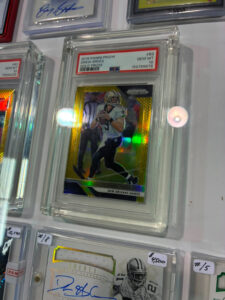
The Grading Industry Went Into Overdrive
Through October 2026, the major grading companies had already graded approximately 31.9 million cards, surpassing the 26.6 million graded during all of 2025.
PSA alone graded nearly 2.8 million cards in October. Meanwhile, its announced $200 million investment into expanding operations demonstrates just how much future demand the company is anticipating.
RipsChart+1
Imagine telling somebody at a card show in 2016 that nearly four million trading cards would eventually be graded in a single month.
But there's another side to this conversation.
Those cards are continually entering the secondary market. Population reports are expanding, and cards that might have appeared relatively scarce a few years ago aren't necessarily scarce today.
I think understanding supply will become increasingly important for collectors heading into 2027.
The Hobby Got Bigger Than Sports Cards
One of my biggest personal takeaways from 2026 was the opportunity to explore collecting categories that I hadn't previously spent as much time with.
Pokémon, One Piece, Star Wars, entertainment cards and even music-related trading cards are competing for collector dollars.
And when certain sports cards appreciate to the point where they're no longer financially accessible to the average collector, it's perfectly reasonable to expect some of those collectors to explore other categories.
I've found myself doing exactly that.
There's something refreshing about discovering a historically significant card from a movie, television show or musical artist that I grew up with, sometimes for a fraction of what a comparable sports card might cost.
Sports cards aren't operating in a vacuum anymore. They're competing within a much larger collectibles economy.
From Euphoria to Uncertainty
What made 2026 particularly interesting was how quickly the sentiment changed toward the latter part of the year.
According to Collector Nation, modern sports cards declined 3.6% in October and another 4.3% through November 27. Cards from newer sports releases experienced even steeper declines.
Collector Nation
We went from collectors worrying about being priced out of certain cards to wondering whether those same cards might be considerably cheaper a month later.
Some of that could be seasonal. Some could be profit-taking. Some could simply be the result of prices getting ahead of themselves.
I also wonder how much discretionary income the average collector has left after a year filled with expensive new releases, card shows, grading fees and rising singles prices.
At some point, the hobby has to reckon with the financial limitations of its participants.
What Did We Learn in 2026?
For me, the biggest lesson is that the growth of the trading card industry and the financial performance of individual cards are two entirely different conversations.
The industry could experience tremendous growth in 2027 while millions of individual cards decline in value.
I'm still incredibly optimistic about collecting. I love going to card shows, talking with other collectors, discovering overlooked cards and adding pieces of history to my personal collection.
But I also don't feel obligated to participate in every market trend, chase every new release or buy every card that somebody tells me is the next big thing.
Sometimes the best purchase is the card you didn't buy.
2026 gave us record sales, unprecedented grading volumes, manufacturing changes, speculation, euphoria, controversy and plenty of reminders that nobody has this market completely figured out.
Are we entering a golden age of trading cards, or are we building toward another significant market correction?
Perhaps the answer is a little bit of both, depending on what you're collecting.
Whatever happens in 2027, I have a feeling we're not going to be short on things to talk about.